


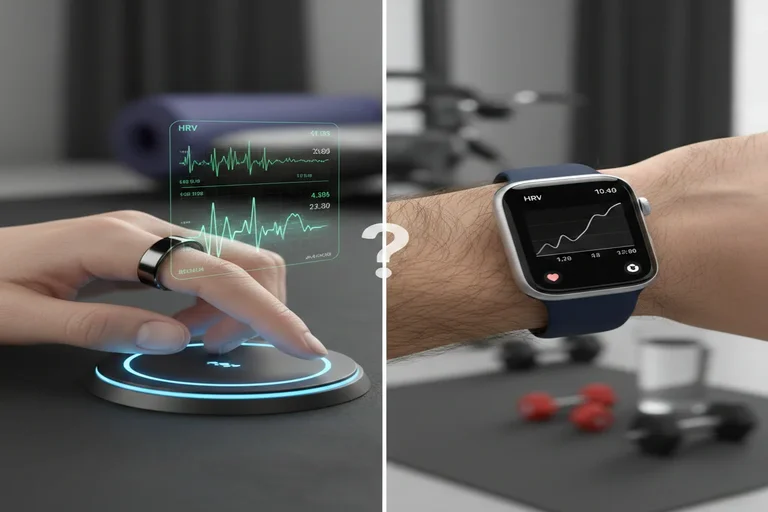
Smart Rings VS Apple Watch Which Tracks Better for HRV
In the rapidly evolving world of health technology, the quest for the “perfect” biometric has led us to heart rate variability (HRV). Once a metric reserved for elite athletes, HRV is now a mainstream indicator of stress, recovery, and overall nervous system health. But as we move into 2026, a critical debate has emerged for biohackers and health enthusiasts alike: smart rings vs. Apple Watch, which one actually tracks HRV better?
At Amber’s Research, we focus directly on the raw data instead of getting distracted by marketing claims. If you’re trying to choose between a ring and a watch to track your recovery, you need to clearly understand the physiological and technological differences between these two devices.
Understanding the Difference; Smart Rings VS Apple Watch
The core difference between the smart ring vs Apple Watch tracking lies in the anatomy of your hand.
The Apple Watch uses a wrist-based photoplethysmography (PPG) sensor to track your data. Although the technology is highly advanced, the wrist makes it harder to capture clean and accurate readings. Movement, hair, and the natural distance between the skin and the radial artery can all create “noise” that interferes with the signal.
On the other hand, smart rings like the Oura Ring or the Samsung Galaxy Ring sit on the finger. The blood vessels in your fingers are much closer to the surface, and the skin is thinner. This allows the infrared sensors in a ring to capture a much cleaner signal compared to a watch worn on the wrist.
The Science of HRV Accuracy
When we compare smart rings vs. Apple Watches for HRV, we are essentially looking at how they measure the milliseconds between your heartbeats.
According to a study published in the Journal of Medical Internet Research (JMIR), finger-based PPG sensors often show a higher correlation with gold-standard ECG (electrocardiogram) readings during sleep than wrist-based sensors. This is because, during the night, your finger remains relatively still, allowing a device like the Oura Ring to ping your arteries with extreme precision.
Why the Apple Watch Is a Strong Contender
Don’t count the Apple Watch out just yet. Apple has invested billions of dollars into developing its advanced sensor system. The watch uses green LEDs for daytime tracking and switches to infrared sensors at night to improve accuracy.
Although the wrist naturally creates more signal noise, Apple’s algorithms do an excellent job of filtering out movement and other artifacts. However, when you compare smart rings directly with the Apple Watch, the watch usually needs a much tighter fit on the wrist to achieve the same baseline accuracy that a ring can deliver more consistently
Nighttime Recovery: Where Smart Rings Shine
For most users, HRV is best measured during sleep to avoid the noise of daily stress and caffeine. This is where the smart rings vs. Apple Watch debate leans heavily toward the rings.
- Form Factor: Wearing a heavy watch to bed can be uncomfortable and can shift during the night, leading to gaps in your HRV data.
- Continuous Monitoring: The Samsung Galaxy Ring and Oura are designed to monitor continuously throughout the night.
- Signal Quality: Because the ring fits snugly around the finger, there is almost zero light leakage, ensuring the sensor captures every pulse wave accurately.
If your primary goal is to wake up and see a Readiness Score based on your autonomic nervous system, Smart Rings currently hold the edge in consistency.
Daytime Performance and Activity
While rings win the night, the Apple Watch often wins the day. During high-intensity workouts, a smart ring can struggle. The “grip” required for lifting weights or the vibration during a run can displace a ring’s sensors.
When you compare smart rings with the Apple Watch for active daytime use, the watch captures heart rate variability (HRV) more frequently throughout the day. However, daytime HRV is highly volatile. Even a single stressful email can lower your HRV for several minutes.
That’s why researchers generally consider nighttime baselines more actionable. During sleep, your body stays in a more stable state, which allows smart rings to capture cleaner, more reliable recovery data.
Data Privacy and Research Transparency
At Amber’s Research, we value transparency. When you look at smart rings vs Apple Watch, you are also choosing an ecosystem.
- Apple Health offers strong privacy protections, but its HRV data is often raw and requires third-party apps like Athlytic or Bevel to interpret it meaningfully.
- In contrast, the Oura Ring and Samsung Galaxy Ring provide highly curated scores. While these scores are convenient, they can sometimes feel like a black box, where it’s unclear why your score is low or what specific research informs it.
A report on PubMed regarding wearable validation suggests that while both devices are excellent for tracking trends, neither should be used as a clinical replacement for a medical-grade ECG. They are tools for directional health, not diagnostic certainty.
Smart Rings vs Apple Watch: Key Advantages and Disadvantages
The Smart Ring (Oura, Samsung)
Advantages: Superior nighttime accuracy, better battery life (5-7 days), discrete design, and high correlation with ECG during sleep.
Limitations: Smart rings aren’t ideal for weightlifting; they can be easy to misplace, some (like Oura) require subscription fees, and they offer limited smart features compared to a full smartwatch.
The Apple Watch
Advantages: Features an advanced multi-sensor array (ECG, blood oxygen, fall detection), offers a best-in-class app ecosystem, and provides basic health data without any subscription.
Limitations: Battery life requires daily charging, it can feel bulky during sleep, and wrist based noise can sometimes skew HRV readings.
Final Recommendation: Which One Should You Choose
So, when comparing smart rings with the Apple Watch, which one does a better job tracking HRV?
If you want the most accurate, consistent, and research validated nighttime HRV baseline, the Smart Ring is the winner. The physiology of the finger simply provides a better window into your heart’s rhythm while you sleep.
However, if you want a holistic health tool that tracks your workouts, monitors for AFib, and integrates with your entire digital life, the Apple Watch is the superior device. Its HRV tracking is more than “good enough” for 95% of users.
Ultimately, the best device is the one you’ll consistently wear. In health research, consistency is the most important factor. Whether you choose a smart ring vs Apple Watch, the real value comes from long-term trends rather than a single day’s reading.
By focusing on the data and ignoring marketing hype, it’s clear that both devices are impressive feats of engineering. However, for those committed to tracking recovery with scientific precision, the smart ring currently takes the crown for HRV accuracy.
Read more related blogs: https://www.ambersresearch.com/edge-ai-vs-cloud-why-your-next-smartwatch-wont-need-internet/
FAQS
Q1: What is HRV and why is it important?
Ans. HRV (Heart Rate Variability) measures the time between heartbeats. It helps track stress levels, recovery, and overall heart health. Monitoring HRV gives insights into your body’s daily wellness.
Q2. Can smart rings track HRV accurately?
Ans. Yes, smart rings like Oura Ring track HRV continuously. They provide detailed data on sleep, stress, and recovery. Many users find their insights more consistent than those of other wearables.
Q3: Are there any limitations of HRV tracking on wearables?
Ans. Accuracy can vary based on device, sensor type, and activity level. Smart rings give more consistent data, while watches may fluctuate with wrist movement. Users should consider their daily routines when choosing.