


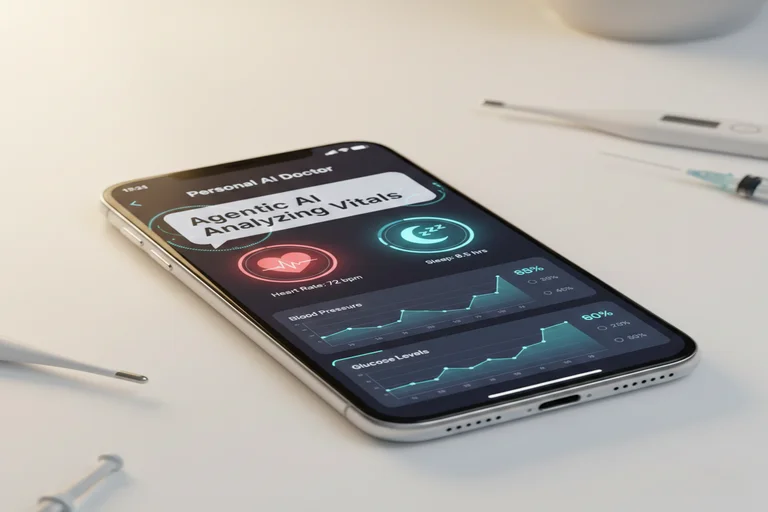
Agentic AI Why Your Next Health App Will Act Like A Persnol Doctor
For years, smartwatches and health apps have behaved like digital librarians, collecting heart rate data, step counts, and sleep cycles into endless charts. But data without action is just noise. We are now witnessing a fundamental shift from passive tracking to active intervention, driven by a breakthrough known as agentic AI. Unlike earlier, basic AI systems that only answer questions or generate text, agentic AI can reason, plan, and autonomously execute health-related tasks. It represents a move away from apps you check toward “agents that check on you.
What is Agentic AI and How Does it Work?
To understand agentic AI, we first need to see how it differs from the “passive AI” we have used for years. Most current health apps rely on basic algorithms: if your heart rate rises above 100 while you are sitting, the app sends a generic alert. This response follows a linear pattern. In contrast, agentic AI operates through what researchers call a reasoning loop. It does not simply register a data point; it interprets context. It observes the data, considers possible causes based on your medical history, and then decides on a specific action. This autonomous behavior is why experts often describe it as a “medical agent” rather than a simple software program.
The core of Agentic AI lies in its ability to break down complex health goals into smaller, manageable steps. For example, if your goal is to manage hypertension, the agent doesn’t just track your blood pressure. It autonomously monitors your sodium intake through your diet logs, correlates it with your sleep quality from your wearable, and adjusts its recommendations in real time. According to recent technical insights from Google Health AI, the shift toward agentic systems is what allows technology to move from simple pattern recognition to actual problem-solving. This means the AI is no longer just a mirror reflecting your data; it is an active participant in your health journey.
Agentic AI vs Generative AI: What’s the Big Difference?
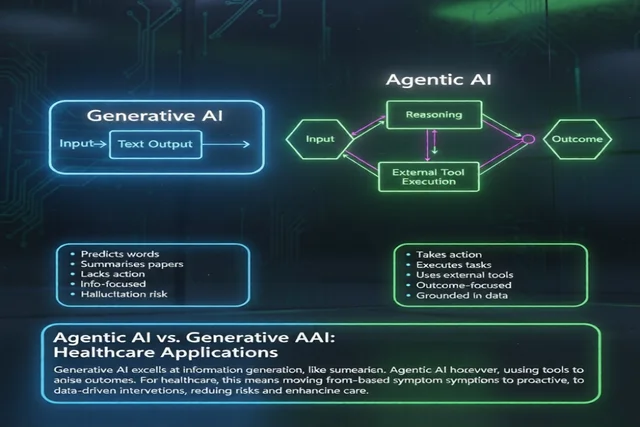
It is easy to confuse agentic AI with generative AI (such as ChatGPT), but for healthcare researchers, the difference is significant. Generative AI focuses mainly on predicting words. It excels at summarizing medical papers or explaining symptoms in plain language, but it lacks agency—it cannot take action. If you tell a generative AI chatbot that your chest hurts, it may list possible causes based on its training data. In contrast, agentic AI goes beyond conversation and acts within a defined framework of bounded autonomy.
The key distinction is that generative AI focuses on information, while agentic AI focuses on execution. A generative model may help you create a meal plan, but an Agentic AI system cross-references that plan with your real-time blood sugar levels from a continuous glucose monitor (CGM) and proactively warns you before you eat something that could cause a spike. This shift from text-based AI to action-based AI creates a true personal doctor experience. By prioritizing outcomes over conversation,Agentic AI also reduces the hallucination risks commonly associated with standard chatbots because it remains grounded in real, clinical-grade data.
How Agentic AI Provides Proactive Medical Care
The most significant change Agentic AI introduces is the shift from reactive notifications to proactive medical care. Most people are familiar with health apps that only respond when prompted—you open the app, check a chart, and try to interpret what it means. In contrast, an autonomous agent acts like a vigilant medical partner. It doesn’t wait for you to feel sick; it monitors the subtle physiological changes that often precede illness. By analyzing trends instead of isolated data points, these systems can detect pre-symptomatic markers, providing a level of oversight previously available only in a hospital.
This personal doctor experience relies on continuous reasoning. If your resting heart rate starts trending upward while your heart rate variability (HRV) drops, Agentic AI doesn’t just issue a warning. It cross-references your calendar, recent activity, and even local weather or air quality to provide a contextual explanation. According to research frameworks highlighted by Stanford Medicine’s Digital Health Lab, such autonomous systems aim to reduce the patient’s cognitive load. Instead of expecting you to be the expert on your own data, the AI acts as the expert for you, ensuring that minor health issues are addressed before they develop into chronic problems.
Clinical Grade Data and the Role of FDA-Cleared Algorithms
The biggest barrier between a fitness app and a personal doctor is the quality of data and the reliability of the logic driving it. For agentic AI to make meaningful medical decisions, it must rely on clinical-grade data rather than estimated fitness metrics. This is where the difference between consumer-grade and medical-grade sensors becomes critical. While many wearables track health, only those using FDA-cleared algorithms are legally and scientifically recognized to provide diagnostic-level insights.
The regulatory landscape is rapidly evolving to accommodate these autonomous systems. In a landmark move in December 2025, the U.S. Food and Drug Administration (FDA) announced the use of its own Agentic AI capabilities to modernize scientific review and pre-market processes. This step from the world’s leading health regulator signals that “agency” has become the new gold standard for medical AI. By early 2026, over 1,200 AI-enabled medical devices had received FDA clearance, with an increasing number incorporating autonomous reasoning loops instead of relying on static code.
For the user, this means your next health app isn’t just “guessing” based on a generic database. Instead, it is using a medical agent that operates within a predetermined change control plan (PCCP), a regulatory framework that allows the AI to learn and adapt its model over time while staying within pre-approved safety limits. By ensuring your health app uses these cleared algorithms, you move away from the hallucinations common in standard AI models and toward a system that provides evidence-based, clinical-grade care.
Privacy and Ethical Considerations
As health apps transition into autonomous agents, they begin to process what researchers call a digital twin a virtual, highly sensitive map of your biological and genetic data. With this level of autonomous decision-making comes immense responsibility. For agentic AI to be trustworthy, it must move beyond basic encryption. At Amber’s Research, we emphasize that data must be handled through Privacy-by-Design frameworks, where user consent is not just a checkbox but a transparent process. According to ethical guidelines discussed by Stanford Medicine, users must have full visibility into how an AI derives its decisions to ensure they remain in control of their personal health journey.
Ethical frameworks become even more critical when an AI predicts medical risks before they happen. It is vital to understand that Agentic AI is an augmentation of human expertise, not a replacement for a qualified clinician. To prevent the misuse of autonomous health guidance, developers are now integrating “Explainable AI” (XAI) features. This means the app doesn’t just give a recommendation; it provides the clinical reasoning behind it, backed by disclaimers and immediate options to consult a human doctor. By maintaining this balance, technology can provide proactive care without compromising the fundamental principles of medical ethics and patient autonomy.
The Future Outlook: Will AI Agents Replace Human Doctors
The rise of autonomous systems often leads to the question of whether human medical professionals will become obsolete. However, research indicates a more collaborative future. Rather than replacing doctors, Agentic AI is designed to eliminate “data fatigue” by acting as a high-level medical co-pilot. By the beginning of 2026, clinical insights from The Lancet Digital Health suggest that AI agents are most effective when they handle routine monitoring—such as summarizing weeks of wearable data—leaving complex diagnostic reasoning to human experts.
In this upcoming ecosystem, the AI agent acts as a bridge. It prepares “Medical Intent” reports that allow physicians to spend less time on charts and more time on patient care. Leading institutions like Stanford Medicine’s AIMI Center are already pioneering frameworks where “Medical Agents” manage chronic condition titration while human doctors remain the final authority for all major interventions. The goal isn’t to replace the doctor; it is to give the doctor more accurate, real-time data to make better decisions.
Read more related articles: https://www.ambersresearch.com/ai-governance-in-healthcare-why-this-is-1-priority-in-2026/
FAQS
Q1: How does Agentic AI differ from a standard health tracker?
Ans. A standard tracker only records data, while Agentic AI actively analyzes it to suggest real-time health actions. It moves your app from just “showing charts” to “solving problems” autonomously.
Q2: Can an AI agent provide a legal medical diagnosis?
Ans. No, it is a screening tool designed to provide clinical-grade insights, not a final legal diagnosis. You should use it to monitor risks and then consult a human doctor for medical confirmation.