



Shadow AI In Healthcare Risks VS Real Research In 2026
The healthcare sector is rapidly embracing artificial intelligence, but not all AI use is approved or monitored. Shadow AI in healthcare has emerged as a pressing concern in 2026, where doctors, nurses, and administrators use generative AI tools like ChatGPT, Gemini, or unauthorized medical bots without institutional consent. While these tools promise efficiency and quick insights, they also pose significant risks, from data leaks to inaccurate medical guidance. Understanding shadow AI in healthcare, its risks, and evidence-backed research is crucial for hospitals and medical professionals aiming to balance innovation with patient safety.
What is Shadow AI in Healthcare?
Simple Explanation:
Shadow AI refers to the use of AI tools in patient care without formal approval from hospital administration. Healthcare staff, including doctors, nurses, and administrators, turn to public AI platforms like ChatGPT or Gemini to handle patient queries, draft medical notes, or summarize research. While the intention is often to streamline tasks, these actions create unmonitored workflows that bypass institutional safeguards.
The Trend:
Reports from 2026 reveal that Shadow AI is essentially an evolution of “Shadow IT,” but with far greater consequences. Unlike typical unauthorized software, AI tools can process sensitive patient data, generate treatment recommendations, or even simulate diagnoses without oversight. These untracked data flows increase exposure to cybersecurity threats, regulatory violations, and patient safety hazards.
2. Why Doctors Are Turning to Shadow AI (The 2026 Reality)
Burnout Crisis:
Healthcare professionals face overwhelming administrative burdens, with studies from 2025-26 indicating that documentation, research, and reporting consume nearly 40% of a doctor’s working hours. To cope, many turn to Shadow AI for assistance in summarizing research papers, creating patient reports, and even drafting medical advice.
Efficiency Gap:
Official AI tools approved by hospitals often lag in speed and flexibility. Public generative AI tools can produce outputs almost instantly, giving staff a tempting shortcut. While these tools improve workflow efficiency, their unregulated use creates the risk of errors, misinformation, and compliance violations.
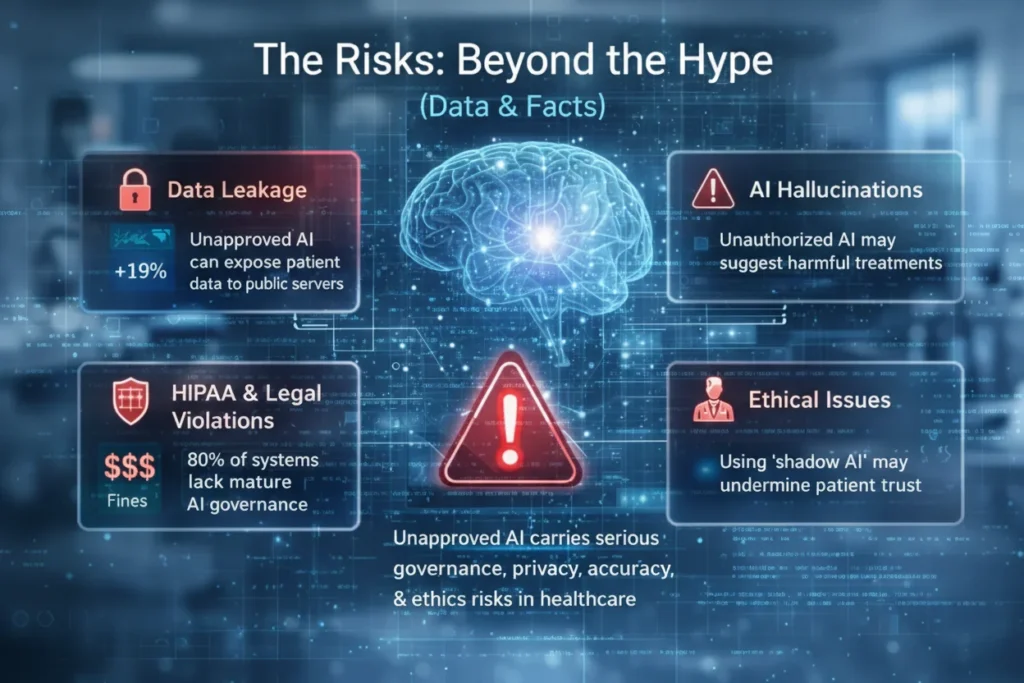
3. The Risks: Beyond the Hype (Data & Facts)
The image below highlights the most critical data-backed risks of Shadow AI in Healthcare, based on real-world findings and 2026 trends.
1. Data Leakage and Privacy Breaches
One of the most serious risks of Shadow AI in healthcare is unintended exposure of patient data. When staff use generative AI tools outside institutional approval, sensitive patient information—including names, diagnoses, lab results, and treatment histories—can inadvertently be uploaded to public servers.
- In 2026, several healthcare systems reported incidents where the use of Shadow AI resulted in the exposure of Protected Health Information (PHI).
- Even small pieces of patient data, when combined with AI logs, can become a privacy vulnerability.
- Unlike approved AI platforms, public AI services often lack healthcare-grade encryption, which makes sensitive data vulnerable and easily accessible to cybercriminals.
- Consequence: data breaches not only compromise patient trust but can also lead to regulatory penalties under HIPAA or GDPR.
2. AI Hallucinations and Misleading Recommendations
Generative AI tools are prone to “hallucinations,” where they produce outputs that look credible but are factually incorrect. In a healthcare context, this risk can become dangerous.
- MedCity News 2025 documented cases where Shadow AI suggested inaccurate medication doses or contraindicated treatments.
- Example: Pregnant patients were given AI-generated advice that could have led to adverse effects.
- Hospitals and clinics that rely on AI without verification risk clinical errors and potential harm to patients.
- This risk is amplified because AI often cannot distinguish between reliable and unreliable sources unless trained on curated medical datasets.
3. Regulatory and Legal Risks
Using unapproved AI tools exposes healthcare organizations to legal and compliance consequences:
- In 2026, more than 80% of hospitals still do not have mature AI governance frameworks, which leaves them exposed to the risks of Shadow AI misuse.
- HIPAA violations can result in hefty fines, lawsuits, and reputational damage.
- Even if a staff member uses Shadow AI to improve workflow efficiency, the institution is legally responsible for any breach or misinformation.
- Shadow AI also makes auditing and accountability more difficult, as AI-generated notes often go untracked and may not be properly validated or stored.
4. Ethical Concerns and Professional Accountability
Beyond technical and legal risks, Shadow AI raises ethical questions:
- Decisions guided by unmonitored AI can undermine professional responsibility.
- Patients may unknowingly receive guidance shaped by AI outputs that clinicians have not reviewed or verified.
- Using Shadow AI without transparency can weaken trust between patients and healthcare providers.
- Medical staff might also face ethical dilemmas if AI recommendations conflict with evidence-based practices.
5. Cumulative Risk: When Convenience Backfires
While Shadow AI may save time and reduce administrative workload in the short term, it creates serious long-term risks.
- Every small, unsupervised use of AI increases the likelihood of data breaches, misdiagnoses, and regulatory violations. These risks add up quickly.
- The issue is systemic. When multiple staff members use Shadow AI independently, the entire institution becomes more exposed to security, compliance, and patient safety failures.
- Hospitals that choose to ignore Shadow AI risks often end up paying a much higher price later, as reactive damage control costs far more than proactive governance and oversight.
4. Real Research vs. Shadow AI Hype
Generative AI has become one of the most hyped technologies in healthcare. Many vendors, media outlets, and even some clinicians talk about AI as if it can instantly transform patient care, reduce medical errors, and replace entire workflows. While there is real promise, the research tells a more nuanced story than the hype suggests.
Hype:
There’s a popular narrative that AI tools, especially large language models like ChatGPT, Gemini, or similar agents, can diagnose conditions, predict outcomes, and generate perfect medical summaries on demand. Headlines sometimes glorify these tools as faster and even more accurate than clinicians themselves. But these claims are often exaggerated, and too many AI claims focus on what could be possible in the distant future rather than what is reliably demonstrated today.
Real Research:
In contrast, research and expert analyses make it clear that AI’s effectiveness depends heavily on governance, data quality, training, and oversight—and that unsupervised or unauthorized use of AI (i.e., Shadow AI) can produce misleading results or unsafe recommendations.
Studies and industry analysis highlight that generative AI can oversimplify scientific and medical content, sometimes producing misleading summaries or incorrect data interpretations. For example, a journal study analyzing thousands of AI-generated summaries found that models can distort key research findings, oversimplify details, or misrepresent nuanced clinical results—which is dangerous when those summaries are used in care decisions.
Shadow AI specially creates a governance gap: when clinicians or staff use public AI tools without oversight, there is increased risk that patient information is handled outside authorized systems, and the AI models lack the clinical validation and regulatory safeguards that approved tools undergo. According to TechTarget reports, experts warn that Shadow AI can operate outside visibility, making it extremely difficult for IT or compliance teams to manage risk effectively.
Even well-respected industry surveys show that healthcare organizations are attempting to adopt AI, but the absence of clear policies & proper oversight means many tools are used informally. As a result, AI outputs may be accepted without verification, increasing the risk of clinical errors, data exposure, and legal complications.
So, the real research suggests that AI in healthcare must be,
- Trained on validated clinical datasets.
- Governed with oversight and compliance checks.
- Used with human-in-the-loop review, not blindly trusted.
Without these safeguards, AI tools—especially unauthorized ones—are more likely to introduce risk than eliminate it.
5. The Solution: How to Stay Safe in 2026
AI Formularies:
Hospitals should maintain a curated list of approved AI tools. Staff must know which platforms are safe and validated for medical use.
Anonymization:
Even when using AI for research summaries or administrative tasks, patient identifiers should be removed or masked. Proper anonymization mitigates privacy risks and aligns with HIPAA requirements.
Transparency & Controlled Enablement:
Rather than outright banning AI, controlled enablement ensures staff can use approved tools safely. Transparent policies, training sessions, and monitoring help integrate AI while minimizing exposure to risks associated with Shadow AI.
Shadow AI is a growing reality in healthcare, driven by burnout, efficiency needs, and the rapid accessibility of generative AI tools. However, unchecked use poses significant threats — from data leakage to hallucinated medical advice and regulatory non-compliance. 2026 research shows that the safe integration of AI requires institutional governance, staff training, and controlled use. Hospitals that understand and manage shadow AI in healthcare can leverage its benefits without compromising patient safety or institutional integrity.
Read more related articles: https://www.ambersresearch.com/what-is-the-future-of-ai-in-healthcare/
FAQS
Q1: What exactly is Shadow AI in healthcare?
Ans. Shadow AI refers to the use of AI tools by healthcare staff without formal institutional approval. These tools can assist with patient care but create unmonitored data flows and potential compliance risks.
Q2: What are the main risks of Shadow AI?
Ans. The primary risks include data leakage, inaccurate AI-generated medical advice, and potential HIPAA or legal violations. Shadow AI tools used without oversight may compromise patient safety and expose hospitals to compliance fines.
Q3: Can AI be safe in healthcare?
Ans. Yes, AI is safe when it is trained on validated datasets, used with proper governance, and supervised by medical professionals. Institutional oversight ensures AI supports care without introducing errors or privacy risks.