


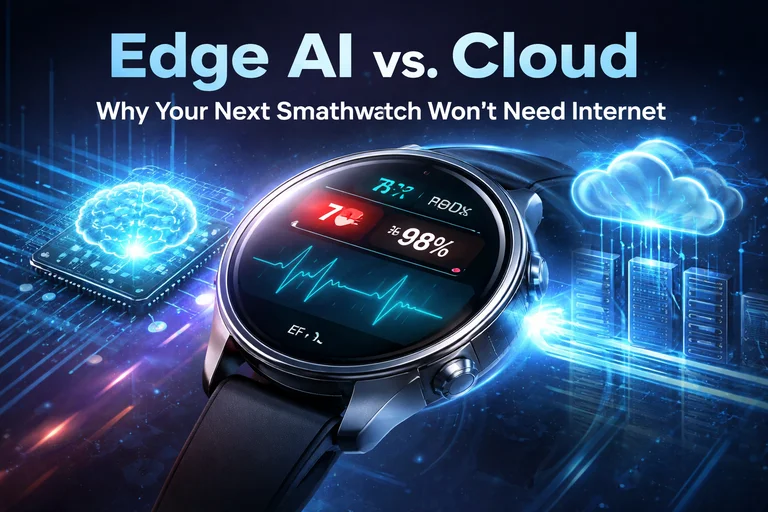
Edge AI VS Cloud Why Your Next Smartwatch Won’t Need Internet
Imagine you’re hiking deep in a remote forest or traveling through a rural area where the internet signal keeps dropping. Your smartwatch now tracks your heart rate, oxygen levels, and sleep patterns accurately in real time—without ever connecting to the cloud. This is not a futuristic dream; it’s the reality of Edge AI vs. Cloud in 2026. The shift from traditional cloud-based AI to edge AI in wearable devices is redefining how we think about biometric data, privacy, and medical-grade accuracy. For health-conscious users, the transition isn’t just a tech upgrade—it’s about clinical reliability and personal data security, ensuring that sensitive health information stays on your wrist, not on a remote server.
The move to Edge AI addresses critical problems that cloud-reliant wearables still face: latency, risk of data breaches, and dependency on continuous internet connectivity. As devices become smarter, more compact, and more energy-efficient, the age of Edge AI is arriving—bringing healthcare monitoring directly to the user, where it matters most.
What is Edge AI vs.Cloud?
The distinction between Edge AI and cloud computing is simple but significant:
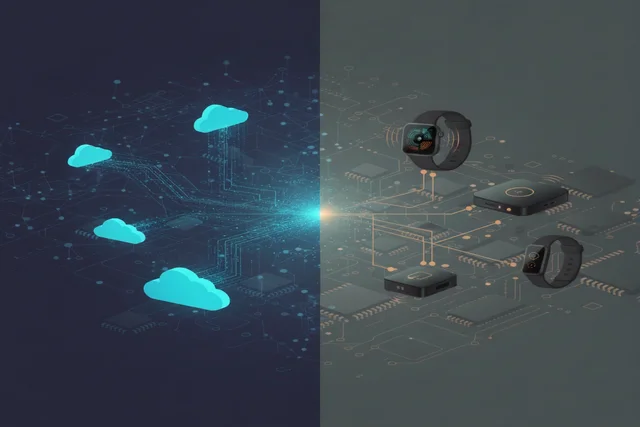
- Cloud Computing: Data from your smartwatch is sent to remote servers for processing. While cloud processing is powerful, it relies on a stable internet connection & raises privacy concerns since sensitive health data travels across networks.
- Edge AI: Processing happens locally on the smartwatch or wearable itself. Algorithms analyze heart rate, sleep patterns, or oxygen levels directly on the device. This reduces latency, protects personal data, and enables real-time feedback without relying on external servers.
By reducing reliance on the cloud, Edge AI lets wearables operate more independently & respond faster. Users gain faster insights, and companies reduce the risk of data breaches or transmission delays.
Hype vs. Reality: Why the Cloud Is Losing Ground
Cloud-based AI once promised seamless data analysis, remote updates, and centralized intelligence. However, the reality in medical wearables often tells a different story:
- Latency Issues: Cloud-based processing sends data back & forth, which causes delays in critical readings. When it comes to ECG abnormalities or sudden drops in oxygen levels, even a few seconds can make a real difference.
- Data Breaches: Centralized health databases have been frequent targets for hackers, exposing sensitive biometric data.
- Dependency on the Internet: Continuous connectivity is unreliable in remote areas or during travel.
- These challenges make Edge AI not just an option but a necessity for wearables that promise real-time medical monitoring and personal data sovereignty.
What is Edge AI in Wearables?
Edge AI refers to processing data locally on the device’s chip rather than sending it to a remote cloud server. In wearables, this means your smartwatch or smart ring handles data collection, analysis, and decision-making internally. The advantages aren’t just theoretical—they revolve around three pillars:
- Data Privacy: Raw health data never leaves the device. Users maintain full control over sensitive information.
- Real-Time Response: Processing data directly on the device removes network delays, enabling instant detection of issues such as irregular heartbeats or low oxygen levels.
- Battery Efficiency: Cutting down on constant data uploads to the cloud greatly extends battery life, which is critical for 24/7 monitoring.
By combining these pillars, Edge AI enables wearables to function independently, securely, and efficiently—without compromising medical-grade performance.
Impact on Clinical Accuracy: Health & Medical Focus
Medical wearables rely heavily on biometric data like heart rate variability (HRV), SpO2, and ECG readings. Traditionally, sending this data to the cloud meant compressing or smoothing raw signals, which could introduce noise and reduce accuracy.
Research shows that on-device processing solves this issue by handling data locally, ensuring faster and more accurate results.
Reduces false positives and negatives in critical alerts.
Enables adaptive AI algorithms that respond to individual user trends, not generic models hosted in the cloud.
For patients monitoring chronic conditions or athletes tracking performance, Edge AI ensures that every beat, pulse, or oxygen fluctuation is recorded with medical-grade accuracy.
Why Your Medical Data Is Safer: Privacy & Security
Edge AI wearables implement a privacy-by-design framework:
- Data Sovereignty: Health data never leaves the device unless explicitly shared by the user.
- Encrypted Storage: All sensitive information is stored locally in secure memory.
- Limited Cloud Use: Only aggregated, anonymized data may be sent for optional analytics or software updates.
This approach contrasts sharply with cloud-dependent wearables, where every reading could potentially be intercepted, raising serious concerns in healthcare applications.
2026 Market Analysis: Leading Devices Integrating Edge AI
The market is rapidly embracing Neural Processing Units (NPUs)—specialized chips designed for Edge AI computation. Leading 2026 wearables include smartwatches capable of continuous ECG monitoring without internet and rings with real-time SpO2 and HRV analysis processed entirely on-device. These devices also use adaptive AI models to personalize alerts based on individual trends. For readers interested in the latest research on Edge AI adoption in healthcare wearables, check out this detailed study by Nature Biomedical Engineering.
Is the Cloud Obsolete? The Verdict
Edge AI doesn’t make the cloud useless, but it does shift the balance. By handling critical health data locally, wearables become faster, more reliable, and privacy-friendly—proving that sometimes, the smartest computing happens right on your wrist.
- Cloud Strengths: Large-scale population studies, firmware updates, AI training, and aggregated analytics still benefit from remote servers.
- Edge AI Dominance: For day-to-day, 24/7 biometric monitoring, immediate feedback, and data sovereignty, Edge AI is clearly superior.
The future of wearables lies in hybrid models—leveraging Edge AI for real-time care and cloud connectivity for optional analysis, research, and long-term storage.
The transition from cloud-based to edge AI wearables marks a paradigm shift in personal health monitoring. Devices now deliver medical-grade accuracy, data privacy, and instant insights, all without depending on internet connectivity. For users who value security and precision, the choice is clear: Edge AI vs. Cloud is no longer a theoretical debate—it’s the standard for smart, reliable, and health-conscious wearables.
As NPUs become more sophisticated, your next smartwatch won’t just track your health—it will analyze, alert, and protect your data locally, ensuring your well-being is always in your hands.
Read more related articles: https://www.ambersresearch.com/what-is-the-future-of-ai-in-healthcare/
FAQs
Q1: What exactly is Edge AI in medical wearables?
Ans. In 2026, Edge AI allows smartwatches to process your health data instantly and correct it on the chip, eliminating the need for an internet connection. This local processing cuts down delays & boosts accuracy for real-time alerts, ensuring your heart rate and sleep patterns are analyzed without lag. Most importantly, it keeps your sensitive biometric information completely private since your data never has to leave your device for the cloud.
Q2. Is the cloud still necessary for smartwatches?
Ans. While Edge AI handles real-time health monitoring, the cloud is useful for aggregated analytics and firmware updates. Researchers or manufacturers may also use it for long-term trend analysis. However, for immediate, personalized alerts, on-device processing is far superior.
Q3: How does Edge AI improve clinical accuracy?
Ans. By processing data directly on the device, Edge AI preserves raw signals such as ECG and SpO2 readings, reducing noise and false alerts compared to cloud-based processing.
Q4: How do NPUs contribute to Edge AI?
Ans. Neural Processing Units (NPUs) are specialized chips that allow wearables to run complex AI algorithms locally. They enable instant detection of irregular heartbeats, adaptive learning for user patterns, and efficient energy use. Essentially, NPUs make Edge AI smart and practical for 24/7 health monitoring.