



AI Governance In Healthcare Why This Is #1 Priority In 2026
Artificial intelligence is no longer an experiment in healthcare. It is already helping doctors detect diseases earlier, manage hospital systems, and personalize treatment plans. But as AI becomes deeply involved in life-and-death decisions, one issue is rising faster than all others: AI governance in healthcare.
In 2026, healthcare leaders, regulators, and patients are realizing that powerful AI systems without strict rules can do more harm than good. Bias in algorithms, misuse of patient data, and unclear accountability are no longer theoretical risks. They are real problems affecting real people. This is why AI governance has quietly become the number one priority shaping the future of healthcare worldwide.
The Shift From 2025 to 2026: Why Urgency Has Increased
Addressing the “Shadow AI” Phenomenon
One defining trend of late 2025 was the rise of shadow AI in healthcare environments. Clinicians, researchers, and administrative teams increasingly began using AI tools independently—often without formal approval, documentation, or oversight. These tools were used for drafting clinical notes, summarizing patient records, analyzing research data, and supporting treatment planning.
While these tools improved efficiency, they also created hidden risks:
AI systems operating outside institutional policies
Patient data processed through unverified platforms
Lack of validation for clinical accuracy
No clear accountability when AI-assisted decisions fail
By 2026, healthcare leaders will recognize that shadow AI is not a fringe issue. It represents a systemic governance failure that exposes organizations to legal, ethical, and patient-safety consequences. Effective AI governance directly addresses this challenge by bringing all AI usage under structured oversight.
Navigating Stricter Regulatory Landscapes
Regulation has become a decisive driver behind governance urgency. The EU AI Act, entering active enforcement phases in 2026, classifies many healthcare AI systems as high-risk technologies. These systems must meet strict requirements related to transparency, risk management, human oversight, and documentation.
In parallel, regulatory bodies and global institutions have reinforced expectations:
The WHO emphasizes ethical AI, patient safety, and accountability.
The FDA continues refining guidance for AI-enabled medical devices.
Cross-border data protection standards demand stronger governance controls.
Together, these developments signal a clear shift: AI governance is now inseparable from regulatory compliance. Healthcare organizations without governance frameworks face operational delays, legal exposure, and reputational damage.
The Core Pillars of Effective AI Governance in 2026
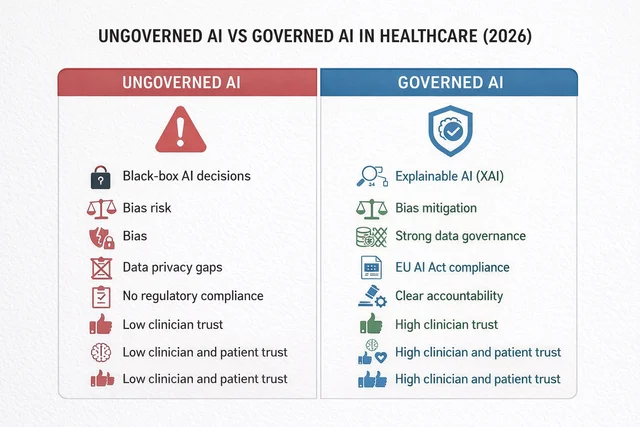
Successful AI governance in healthcare is built on structured, repeatable principles. In 2026, four pillars define governance maturity.
Transparency and Explainability (XAI)
Clinical AI systems must provide understandable reasoning behind outputs. Explainable AI allows clinicians to interpret recommendations, challenge results when necessary, and maintain professional accountability. Without explainability, AI erodes trust rather than enhancing care.
Bias Mitigation and Fairness Controls
AI models trained on incomplete or skewed datasets risk reinforcing healthcare inequities. Governance frameworks require regular bias audits, diverse training data, and continuous performance monitoring to ensure fair outcomes across populations.
Data Sovereignty and Privacy Protection
Healthcare data is among the most sensitive forms of personal information. Governance ensures that data usage aligns with consent rules, regional regulations, and institutional privacy standards. This includes access controls, audit trails, and strict data-handling protocols.
AI Accountability Frameworks
Clear accountability structures define who is responsible for AI outcomes. Governance assigns ownership across leadership, IT teams, clinicians, and ethics committees. This clarity becomes essential when AI systems influence critical patient decisions.
Together, these pillars transform AI from a technological risk into a controlled clinical asset.
Benefits for Key Stakeholders
For Decision-Makers: Mitigating Legal and Financial Risks
Healthcare executives face growing pressure to justify AI investments while managing escalating regulatory expectations. Without governance, AI adoption increases exposure to:
- Regulatory penalties and enforcement actions.
- Litigation related to biased or unsafe outcomes.
- Financial losses from data breaches and system failures.
AI governance provides leadership with predictability and control. Structured oversight allows organizations to document compliance, demonstrate due diligence, and align AI strategy with long-term institutional goals. Governance also enables faster decision-making by reducing uncertainty around AI deployment approvals.
From a financial perspective, governance reduces costly remediation efforts by identifying risks early rather than after failure occurs.
For Clinicians and Researchers: Building Trust and Efficiency
Clinicians are more likely to adopt AI systems they trust. Governance ensures that clinical-grade generative AI tools meet defined performance standards and integrate safely into workflows. When AI recommendations are transparent and validated, clinicians can focus on patient care rather than questioning system reliability.
For researchers, governance frameworks create clear boundaries for ethical AI experimentation. This enables responsible innovation while preserving research integrity and reproducibility. In both cases, governance strengthens confidence rather than restricting progress.
Why 2026 Is a Turning Point for Healthcare AI
Several converging factors make 2026 uniquely significant for AI governance:
- AI systems now directly influence high-stakes clinical decisions.
- Regulatory enforcement is moving from guidance to penalties.
- Autonomous AI capabilities are expanding rapidly.
- Public awareness of AI risks is increasing.
Unlike earlier adoption phases, healthcare organizations can no longer afford reactive governance. The cost of delay is no longer theoretical. Governance failures now carry immediate operational and reputational consequences.
As AI becomes embedded across care pathways, governance determines whether innovation scales responsibly or collapses under regulatory and ethical pressure.
The Business Case for Governance
Beyond ethics, governance makes financial sense. Poorly governed AI can lead to lawsuits, regulatory penalties, and reputational damage. Hospitals that invest early in governance reduce long-term risks and improve operational stability.
Technology companies are also adapting. In 2026, healthcare AI vendors are expected to provide explainability tools, audit trails, and bias assessments. Buyers increasingly demand governance features as part of procurement decisions.
Responsible AI is becoming a competitive advantage, not a limitation.
The Future Outlook: Governance Beyond 2026
AI in healthcare will continue to grow, but its success depends on trust, transparency, and accountability. Governance will evolve alongside technology, shifting from static rules to adaptive oversight models.
Healthcare systems that build governance into their digital foundations today will be better prepared for future innovations. Those who ignore it may struggle with public backlash and system failures.
The direction is clear: governance is no longer behind the scenes. It is shaping how healthcare works.
Why AI Governance in Healthcare Is Non-Negotiable
In 2026, AI governance in healthcare stands as the most important priority because it protects patients, supports clinicians, and safeguards trust in an increasingly digital medical system. AI is powerful, but without clear rules and human oversight, that power can quickly turn into risk.
Strong governance ensures AI remains a tool for healing rather than harm. As healthcare faces growing pressures from technology, climate change, and demographic shifts, governance provides the stability needed to move forward responsibly.
The future of healthcare will not be defined by how advanced AI becomes, but by how wisely it is governed.
FAQS
Q1. What is AI governance in healthcare?
Ans. AI governance in healthcare refers to the rules, policies, and ethical frameworks that guide how AI systems are designed, used, and monitored in medical settings. It ensures accountability, transparency, and patient safety while AI supports clinical decisions.
Q2. Why is AI governance so important in 2026?
Ans. In 2026, AI systems are deeply embedded in diagnostics, treatment planning, and hospital operations. Without governance, risks like bias, data misuse, and unchecked automation can directly affect patient outcomes and public trust.
Q3. How does AI governance protect patient data?
Ans. Governance frameworks set clear rules for data collection, storage, and access. They ensure patient data is used responsibly, securely, and only for approved medical purposes.